 |
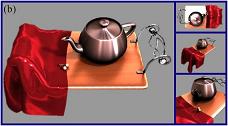
Ben-Artzi, Aner; Overbeck, Ryan; Ramamoorthi, Ravi. Real-Time BRDF Editing in Complex Lighting. To Appear in SIGGRAPH 06. [video] [pdf]
|
 |
Abstract:
Current systems for editing BRDFs typically allow users to adjust
analytic parameters while visualizing the results in a simplified
setting (e.g. unshadowed point light). This paper describes a realtime
rendering system that enables interactive edits of BRDFs, as
rendered in their final placement on objects in a static scene, lit by
direct, complex illumination. All-frequency effects (ranging from
near-mirror reflections and hard shadows to diffuse shading and soft
shadows) are rendered using a precomputation-based approach.
Inspired by real-time relighting methods, we create a linear system
that fixes lighting and view to allow real-time BRDF manipulation.
In order to linearize the images response to BRDF parameters, we
develop an intermediate curve-based representation, which also
reduces the rendering and precomputation operations to 1D while
maintaining accuracy for a very general class of BRDFs. Our system
can be used to edit complex analytic BRDFs (including anisotropic
models), as well as measured reflectance data. We improve
on the standard precomputed radiance transfer (PRT) rendering
computation by introducing an incremental rendering algorithm that
takes advantage of frame-to-frame coherence. We show that it is
possible to render reference-quality images while only updating
10% of the data at each frame, sustaining frame-rates of 25-30fps.
|
|
|
Lawrence, Jason; Ben-Artzi, Aner; DeCoro, Chris; Matusik, Wojciech; Pfister, Hanspeter; Ramamoorthi, Ravi; Rusinkiewicz, Szymon. Inverse Shade Trees for Non-Parametric Material Representation and Editing. To Appear in SIGGRAPH 06. [site].
|
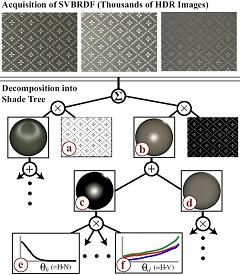 |
Abstract: Recent progress in the measurement of surface reflectance has created a demand for non-parametric appearance representations that are accurate, compact, and easy to use for rendering. Another crucial goal, which has so far received little attention, is editability: for practical use, we must be able to change both the directional and spatial behavior of surface reflectance (e.g., making one material shinier, another more anisotropic, and changing the spatial "texture maps" indicating where each material appears).
We introduce an Inverse Shade Tree framework that provides a general approach to decomposing high-dimensional measured datasets of appearance into sampled 1- and 2-dimensional functions. These functions, the leaves of the shade trees, can capture both the directional behavior of individual materials and their spatial mixing patterns. In order to compute the trees from measured data automatically, we map the problem to matrix factorization and introduce a flexible new algorithm that allows for constraints such as non-negativity, sparsity, and energy conservation. We evaluate our approach with a prototype system that includes interactive rendering and editing tools for manipulating these representations. We demonstrate the ability to reduce multi-gigabyte measured datasets of the Spatially-Varying Bidirectional Reflectance Distribution Function (SVBRDF) into a compact representation that may be edited in real time.
|
|
 |
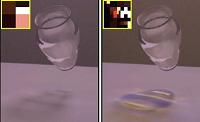
Overbeck, Ryan; Ben-Artzi, Aner; Grinspun, Eitan; Ramamoorthi, Ravi. Exploiting Temporal Coherence for Incremental All-Frequency Relighting. To Appear in Eurographics Symposium on Rendering 2006. [pdf].
|
 |
Abstract:
Precomputed radiance transfer (PRT) enables all-frequency relighting with complex illumination, materials and
shadows. To achieve real-time performance, PRT exploits angular coherence in the illumination, and spatial
coherence in the light transport. Temporal coherence of the lighting from frame to frame is an important, but
unexplored additional form of coherence for PRT. In this paper, we develop incremental methods for approximating
the differences in lighting between consecutive frames. We analyze the lighting wavelet decomposition over typical
motion sequences, and observe differing degrees of temporal coherence across levels of the wavelet hierarchy. To
address this, our algorithm treats each level separately, adapting to available coherence. The proposed method
is orthogonal to other forms of coherence, and can be added to almost any all-frequency PRT algorithm with
minimal implementation, computation or memory overhead. We demonstrate our technique within existing codes
for nonlinear wavelet approximation, changing view with BRDF factorization, and clustered PCA. Exploiting
temporal coherence of dynamic lighting yields a 3×4× performance improvement, e.g., all-frequency effects
are achieved with 30 wavelet coefficients per frame for the lighting, about the same as low-frequency spherical
harmonic methods. Distinctly, our algorithm smoothly converges to the exact result within a few frames of the
lighting becoming static.
|
|
 |
Ben-Artzi, Aner; Ramamoorthi, Ravi; Agarwala, Maneesh. Efficient Shadows from Sampled Environment Maps. Journal of Graphics Tool. 11, 1. 13-36 [site]
|
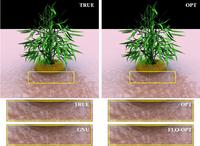 |
Abstract: This paper addresses the problem of efficiently calculating shadows from environment maps. Since accurate rendering of shadows from environment maps requires hundreds of lights, the expensive computation is determining visibility from each pixel to each light direction, such as by ray-tracing. We show that coherence in both spatial and angular domains can be used to reduce the number of shadow rays that need to be traced. Specifically, we use a coarse-to-fine evaluation of the image, predicting visibility by reusing visibility calculations from four nearby pixels that have already been evaluated. This simple method allows us to explicitly mark regions of uncertainty in the prediction. By only tracing rays in these and neighboring directions, we are able to reduce the number of shadow rays traced by up to a factor of 20 while maintaining error rates below 0.01%. For many scenes, our algorithm can add shadowing from hundreds of lights at twice the cost of rendering without shadows.
|